
How the site works
I. Fundamental Principle of the Site’s Operation
The digital hyperlink serves medieval intertextuality. The citation that Peter Lombard drew from the Church Fathers, and that the future master reused in his commentary, is both what connects medieval texts to one another and what, on this site, carries the digital hyperlink.
II. The User’s Path
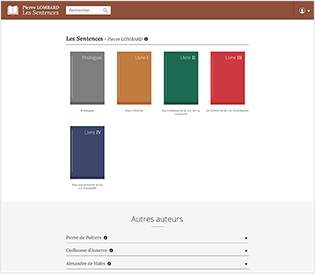
Before reaching the actual text of the Sentences or the commentaries, you must make a series of choices: select an author among all the masters, choose one of the four books, and then select a distinction among the many that compose a book.
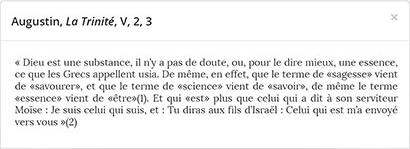
Once in front of the text, you can simply read it or activate a hyperlink. This hyperlink is carried by a citation. Note that every citation appears on a colored background and changes color when you hover over it with your mouse. You can then click on it. When you do, a record (or entry sheet) appears on the screen.
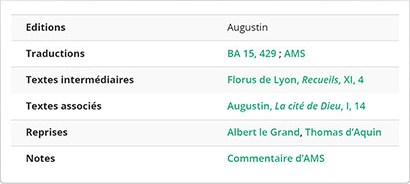
Cette fiche comprend 6 entrées :
- 1. Version
- 2. Translation
- 3. Intermediate texts
- 4. Associated texts
- 5. Reuse
- 6. Critical notes
1. Versions
The citation you see may vary from one version or edition to another. It is quite rare that the author you are reading had access to a text identical to the critical edition we have today. Therefore, by clicking on “Versions,” you access a page presenting the different versions currently available.
2. Translation
This section provides translations of the various versions listed in section 1.
3. Intermediate Texts
Sometimes an author does not have direct access to the work they are citing and instead relies on an intermediate source. This intermediary is often a collection of selected excerpts, more readily available. Additionally, for certain citations—such as those from the Glossa Ordinaria—we are dealing with a “woven fabric” of multiple quotations that must be carefully disentangled.
4. Associated Texts
This link is specific to medieval studies and takes into account two often overlapping aspects: an author may return multiple times to the same idea, allowing us to identify the same citation ad sensum (in meaning). Furthermore, since the citation carrying the hyperlink may itself be imprecise, a parallel text—known or unknown to the medieval master—can sometimes provide elements ad litteram (word-for-word).
5. Reuses
These indicate which authors reuse the same citation at the same place in their commentary. By clicking on a name, you are taken to that author’s page where the same citation can be read.
6. Critical Note
The existence of different versions of a citation shows that citations themselves have a history. This note summarizes the current state of research and functions as a synthesis of sections 1 and 3–5.
These six sections will be progressively enriched as the site develops. It should also be noted that not every citation is necessarily reused later, nor does it always have an intermediate or associated text—at least, not yet identified by research. However, each record can always be further developed as scholarship advances.
III. The Different Menus
Users can navigate from an author to a citation and, through the record, access the six hyperlinks described above. They can also explore the site transversally through various menus.
Top menu: Allows navigation between authors and books, and provides a search engine covering the entire site. 
Right menu: Allows navigation between distinctions within the same book. For each distinction, it also provides access to a summary notice (Details of the distinction), presenting the sources that contributed to the text, and a detailed record (Commentary), addressing critical, historical, or literary issues related to the distinction. 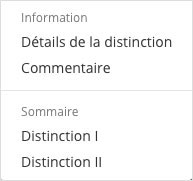
- Left menu: Allows users to choose their language. Medieval texts are originally in Latin, but the site offers several French translations. A feature also allows side-by-side display of the Latin text and its French translation. Additional languages will be added over time.
